

How To Install A Bathtub In A Basement
By Matt Weber , Photos By Hal Jones
Creative thinking combined with innovate building products give rise to a cute basement bathroom.
Hal Jones was adding a new bathroom in the partially finished basement of his family'southward lake house. Working in his favor was the fact that the unfinished infinite gave him a fresh canvas on which to install the bathroom amenities. However, working against him was limited square footage considering the side by side areas had already been partitioned into finished rooms. Plus, the area of construction was located on a solid concrete slab, with no drain arrangement in place. Hither'south how Hal employed traditional techniques, state-of-the-art fixtures and new DIY-friendly materials to conquer those obstacles and create a bathroom to brag about.
Fixture Fix-Upwards
The plumbing fixtures provide the function and focal points of a bathroom, and Hal chose Kohler fixtures to outfit the projection. Kohler'due south Revival Serial white, porcelain pedestal-style sink provided a sleek look while economizing space. Kohler's matching Revival Summit-Trip high-efficiency toilet featured two interesting top-of-the-line attributes, a bidet (AKA dog water fountain) and an electronically heated seat, making this water closet superlative contender for "Most Lavish Toilet in Winston County, Alabama." The bathtub was Kohler's triangular Cornerstone Whirlpool Bathroom complete with soothing water jets and comfortable armrests to relax in a spa-like atmosphere. Hal was definitely making the well-nigh of this project.
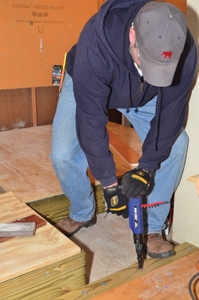
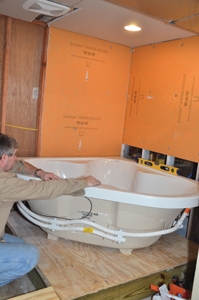
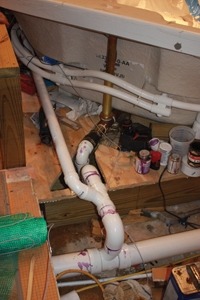
Drain Platforms. The start society of business organisation for the plumbing fixtures was to decide a game plan for addressing the lack of drain plumbing. The solution: Raise the fixtures. Rather than cut into the concrete with a slab saw or jackhammer to make clearance for drain lines, Hal took an alternative arroyo. He constructed joisted a plywood platform for the toilet, like to edifice a miniature deck, which elevated information technology several inches off the flooring and provided just enough space to install the necessary drain lines. The toilet was then installed as usual with a flange and wax ring atop the platform. Hal besides congenital a platform and knee-wall that encased the bathtub drain lines, which were besides routed higher up the slab. Naturally, the fixture platforms reduce headspace when someone is standing on top of them, but Hal decided it was a logical compromise for easier installation on this project.

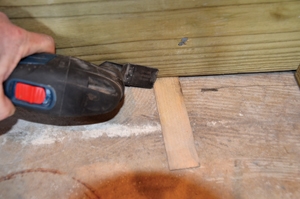
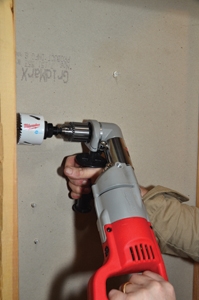
To brand sure the surface of the forest decking had a good waterproof seal from the inevitable drips in a bathroom environment, Hal brush-applied ProFlex Primer and Sealer over the top of the plywood decking.
The above-course bleed lines for the private fixtures all the same didn't address the lack of a main drain stack. To solve this issue, all the plumbing fixtures were tied into a Saniflo SaniCubic pump, located out of view in the unfinished basement on the opposite side of the bathroom wall. The SaniCubic was chosen due to its capacity for handling a washing machine and a future kitchenette addition. The pump includes a macerating blade to liquefy solid waste product, which is so pumped upward to necktie into the existing drain stack of the house.
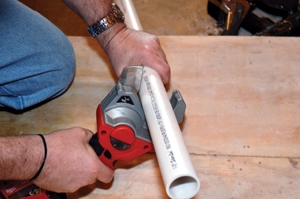
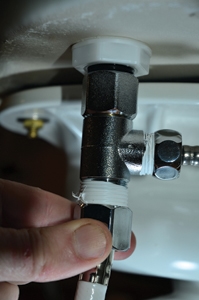
The supply lines for the fixtures were installed using a PEX arrangement, which costs significantly less than traditional copper and is simpler to install. The PEX organisation was tied into a manifold, which enables the various supply lines to be shut off independently for piece of cake installation and maintenance of the plumbing system.
Tile Tactics
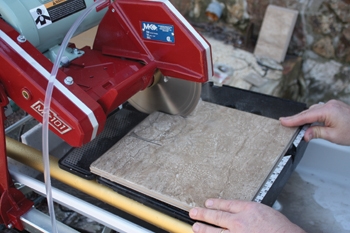
Tile is so widely used in bathrooms because it performs exceptionally well in wet environments. However, tile can also exist catchy to install, requiring backer-board, special cutting tools and skilled installation techniques. For this chore, Hal combined traditional methods with some innovative new products that quickened the stride of installation.
Wall Tile. Quality tile installation requires the use of a backer-lath on which to apply the adhesive and tile. However, traditional physical backer-board is heavy and hard to cut without generating a lot of lung-clogging dust. That'due south why Hal opted for Schluter-KERDI board instead of concrete board for the vertical installation. Schluter-KERDI is a bonded waterproof membrane fabricated of soft polyethylene (similar to rigid cream insulation). Ideal for ceramic and stone tile, the backer-board textile is covered on both sides with special fleece webbing to anchor the thinset mortar.
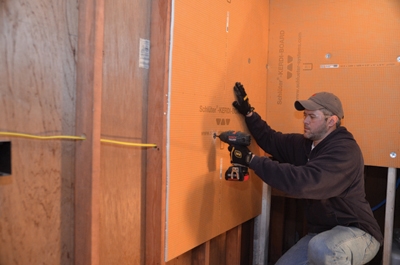
The Schluter-KERDI offered a handful of advantages. Being so lightweight, it was like shooting fish in a barrel to position on the wall and zap in place with a powered screwdriver—with no-pre-drilling. And, rather than kicking upward a grit-storm by using a special concrete blade on a circ saw, the Schluter-KERDI capitalist-boards tin can easily be cutting in place with a sharp utility knife. Plus, the material is printed with a i/ii-inch filigree, which provides a guide to ensure square installation and makes it easy to follow the lines when cutting.
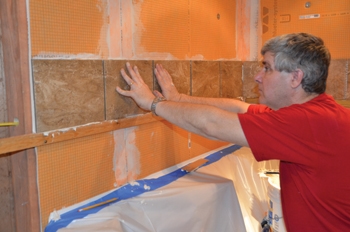
This printed filigree came in handy when Hal installed a level ledger board on the Schluter-KERDI above the bathtub. Post-obit the filigree line, Hal nailed the ledger in place to serve two purposes. First, information technology provided support from below for the wall tile. He began installation above his level ledger, mortaring row after row of tile and using tile spacers between each joint. In some cases, vertical tile installations can slide when installed, misaligning the layout. Nonetheless, the ledger supported the weight of the tile while the mortar dried, preventing whatsoever movement.

The 2nd purpose of the ledger was to serve equally a placeholder for a row of mosaic accent tiles that would serve as a kind of decorative chair rail throughout the bathroom. The ledger had been cut the same size equally the accent tiles, and then upon removal it left a perfectly sized strip to install the chair rail.
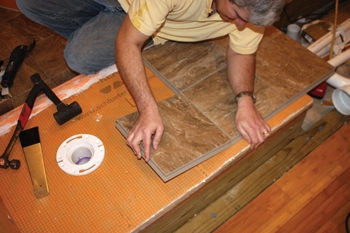
Bath Flooring. To make the bathroom floor as comfortable as possible, Hal incorporated an electric radiant heat arrangement. This easy-to-install organisation utilizes a wire-embedded mat that is installed beneath the finished flooring. Just road the mat throughout the floor, staple in place and connect the terminals to the organisation's thermostat and power supply. The radiant system heats on control to provide a toasty walking surface that'south much friendlier to bare feet than cold porcelain.

The radiant mat was then covered with Daltile's new Cliks flooring tile, which went down with lightning speed. Cliks is the brand name of the company's new interlocking porcelain floor tile. Featuring the same patented tongue-and-groove UniClic System popularized past laminate floor manufacturers, the edges of the interlocking tiles join at 20- to 30-degree angles and then fold downward to shut the joint. The Cliks system is a floating floor, and the closed T&G joints look similar finished grout joints. These unique features completely eliminate the mess and labor associated with grout and thinset mortar, so a new porcelain flooring can be completed in as little equally a unmarried afternoon.
Odds and Ends
Wall Pigment. Bath paints are field of study to moisture daily and this is no area to compromise on product selection. For the drywall areas not covered by tile, Hal chose Behr Premium Plus Ultra Satin in "Arctic Body of water" for his walls and for the ceiling chose an eggshell cease in the "Calorie-free French Gray." This is Behr'due south superlative of the line paint, and we like information technology for its high quality, durability and the time-saving inclusion of primer with the topcoat.
Moisture Ventilation and Insulation. All baths should contain adequate ventilation, and this is especially critical for a basement bath that is below footing level. In the bath ceiling Hal installed Broan's QTXE 150, an Energy Star-rated exhaust fan that moves 150 cubic anxiety of air per minute to keep mold and mildew issues at bay even in these extreme conditions.
The other result was preventing wet from penetrating through the bath area into the surrounding non-vented living areas. While the stud cavities were exposed, Hal used Versi-Foam Spray Insulation past RHH Foam Systems to encapsulate the bathroom walls and prevent moisture migration, heat transfer and aid soundproofing.
Mission Accomplished
A custom bath renovation can vary wildly in design, and every project seems to have its special prepare of challenges. One of the central solutions to this projection was the utilize of elevated drain platforms in lieu of tearing apart the physical slab. However, with conscientious employ of space and some neat new products that simplified installation, Hal managed to create a contemporary bathroom that had lots to offering in such a little space.

Resources
Behr, world wide web.behr.com
Broan-NuTone, world wide web.broan.com
Daltile, www.daltile.com
Kohler, www.kohler.com
Proflex, world wide web.proflex.united states of america
Saniflo, world wide web.saniflo.com
Schluter-KERDI, world wide web.schluter.com
Versi-Foam, world wide web.rhhfoamsystems.com

Source: https://extremehowto.com/install-a-basement-bath/
Posted by: higginsbuttleace.blogspot.com
0 Response to "How To Install A Bathtub In A Basement"
Post a Comment